
1. Why do chemical bonds form?
What makes atoms stick?
We learnt that the world around us is made up of elements and compounds. What types of forces hold two or more atoms together in the elemental or compound state?

A chemical bond is the electrostatic attraction (positive charge attracting negative charge) that binds particles together to form matter.
Types of bonds
-
When different types of particles interact electrostatically, different types of chemical bonds form.
-
Electrostatic attraction is an important factor that ‘motivates’ atoms to form bonds with each other.
-
The manner in which the atoms are bound together has a profound effect on the chemical and physical properties of these substances.


How do geckos defy gravity?
Geckos aren’t covered in adhesives or hooks or suction cups, and yet they can effortlessly scale vertical walls and hang from ceilings. What’s going on? Eleanor Nelsen explains how geckos’ phenomenal feet allow them to defy gravity.
Electronegativity
If two atoms were to form a chemical bond, knowing their electronegativities would tell us what kind of bonds they will form.
-
Large difference in electronegativity (between metals and non-metals) – Ionic bond
-
Small difference in electronegativity (between non-metals) – Covalent bond
2. The Electronic Configuration of a Noble Gas
Tutorial - Noble Gases and Ions
This video will introduce what noble gases are and how ions are formed when atoms gain or lose electrons to obtain the stable noble gas configuration. You will see briefly how the electronic structure of an ion is drawn.
3. Ionic Bonding


3D Visualization of Ionic Compounds
Interact with 3D models of ionic compounds using these Java Applets.
Walkthrough on Ionic Bonding and Properties
This video accompanies the following pages in your textbook:
-
Chemistry Matters TB Pg 66-68, 85-87
-
Discover Chemistry TB Pg 58-60, 75-77
Electrical Conductivity
Learn why some substances conduct electricity while others don't.
Ion: A Molecule Building Game
An Explosively Fun Card Game for 2 -7 players about the chemistry of basic elements, ionic bonding, and everyday compounds!
Tutorial - Dot-and-cross diagrams (Ionic)
Step-by-step tutorial on how to draw dot-and-cross diagrams for ionic compounds.
Fascinating Time Crystal
A time crystal or space-time crystal is a structure that repeats in time, as well as in space. Normal three-dimensional crystals have a repeating pattern in space, but remain unchanged as time passes. Time crystals repeat themselves in time as well, leading the crystal to change from moment to moment.
4. Covalent Bonding

Simulation: Covalent Bonding
In this Chemthink tutorial, you will explore covalent (molecular) bonding and take a short quiz. Topics include:
-
why hydrogen atoms would attract when they share electrons
-
the relationship between distance, potential energy, and force between two atoms
-
naming covalent compounds
View in full screen
Walkthrough on Covalent Bonding and Properties
This video accompanies the following pages in your textbook:
-
Chemistry Matters TB Pg 69-75, 88-90
-
Discover Chemistry TB Pg 61-68, 78-80
Tutorial - Dot-and-cross diagrams (Covalent)
Step-by-step tutorial on how to draw dot-and-cross diagrams for simple covalent molecules
Covalence: A Molecule Building Game
In Covalence, players work together to accurately reconstruct a number of secret organic molecules. One player takes on the role of the “Knower” who has knowledge of the secret molecules, while all other players, “Builders”, must deduce what these secret molecules are, based upon clues given to them by the Knower. All Builders must cooperatively utilize a limited number of clues available in order construct their molecules before the clues run out!
Challenge: Can you draw the dot-and-cross diagrams for polyatomic ions?

5. Giant Covalent Structures
How to make graphene
Graphene is an allotrope of carbon and is 100 times stronger than strongest steel with hypothetical thickness of 3.35 angstroms. It conducts heat and electricity efficiently and is nearly transparent. What potential application do you think this might bring?

Graphene: The Carbon-Based ‘Wonder Material’
Even if you’ve not got a particularly scientific background, you’ve likely at least heard of graphene. Currently, it seems like not a week goes by without a new scientific study on graphene being published, or a new article coming out espousing its potential applications. It might seem hard to believe that graphene itself was only isolated just over a decade ago, back in 2003, by two scientists at the University of Manchester: Andre Geim and Konstantin Novoselov. The method of isolation was somewhat rudimentary: they peeled layers off of graphite, a form of carbon, using sellotape, and kept peeling layers away until they were left with graphene.

New Allotrope of Carbon Discovered!
Researchers from North Carolina State University have discovered an allotrope of carbon they call Q-carbon. It can be used to make diamond-related structures at room temperature and pressure. Read more by clicking the image below.
Tiny Carbon Soccer Balls
Fullerene is an allotrope of carbon with the chemical formula C . Note that it is regarded as a molecule and not a giant covalent structure. Look at how its properties differ from graphite.
60
Application of Carbon Nanotubes
Carbon nanotubes (CNTs) are an allotrope of carbon. They are cylindrical in shape and have unique properties that make them potentially useful in a wide variety of applications in nanotechnology, electronics, optics and other fields of materials science.
6. Metallic Bonding
How to See Atoms
The nanoscopic world is wild!! Looking at basic objects like a grain of salt under an electron microscope looks like nothing you would have expected. Furthermore, have you ever wondered whether seeing a single atom is possible? Or how do scientists and engineers create only a few nanometers wide transistors? In this video, we will explore the electron microscope and how they are used to see nanoscopic objects. Specifically, we'll look at the Transmission Electron Microscope and the Scanning Electron Microscope and dive into how they work.

Metal's Compounding Problem
Scientific facts are hard to remember until author Adrian Amparo spins a tale explaining how pure metals were finally made to combine with other metals to form compounds. This delightful story will add warmth to the cold hard facts of science while reminding us about the benefits of working together.
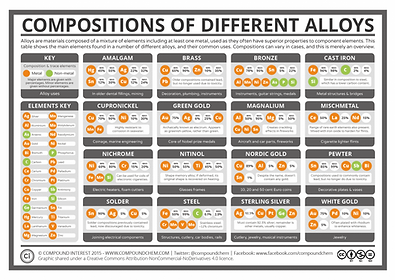
The Elemental Compositions of Metal Alloys
Alloys make up parts of buildings, transport, coins, and plenty of other objects in our daily lives. But what are the different alloys we use made up of, and why do we use them instead of elemental metals?
Shape Memory Alloy: Nitinol
Imagine that your team has discovered a new shape memory alloy called Nitinol. What potential applications would you use it for?